Marine sediments store massive amounts of organic carbon, playing a key role in the global carbon cycle and holding thousands of petagrams of carbon.
Knowledge gap
Despite decades of research, relatively few large-scale studies have attempted to link sediment organic carbon contents with environmental drivers to determine the main regulating factors across regional seas. Identifying these drivers is critical for understanding where carbon stores occur and how they vary across diverse seafloor habitats.
Main approach
We integrated a dataset encompassing sediment organic carbon, benthic habitats, and sediment substrata with 11 different environmental variables across European regional seas.
Technological challenge
To tackle this study, we had to bridge the gap between precise point-based observations of sediment carbon and broader spatially gridded model outputs. We utilized a machine learning boosted regression trees algorithm to model the data, applying hyperparameter tuning and a bootstrapping procedure to quantify uncertainty and capture broad spatial patterns.
Main finding
Our model identified wave exposure, light availability (diffuse attenuation), seafloor geomorphic features, and maximum bottom water temperature as the most important environmental predictors of sediment organic carbon content.
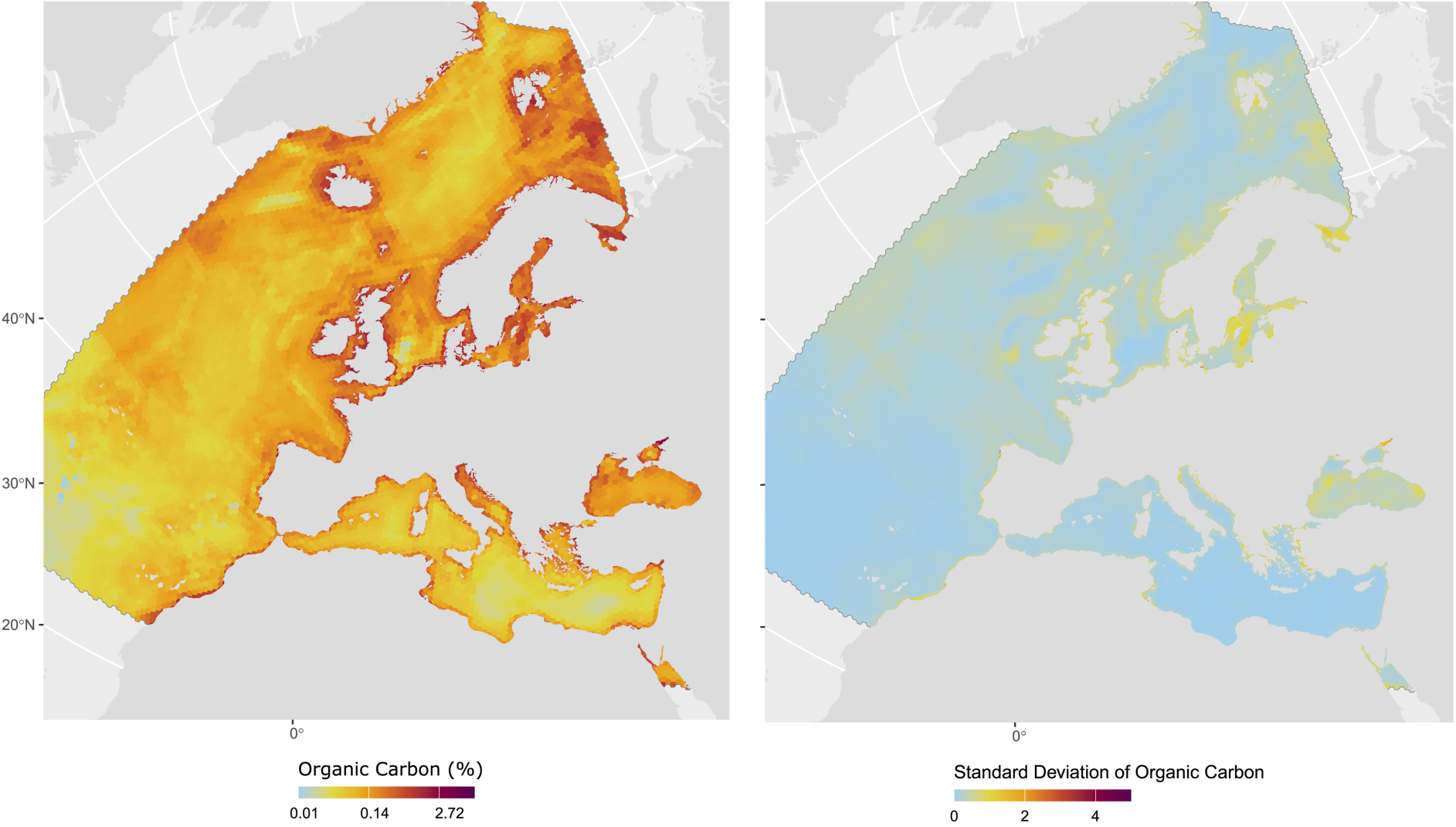
Fig. Maps showing the model predicted (left) percentage organic carbon (%OC) and (right) prediction uncertainty, the standard deviation, across the seven bootstrap models. Higher values in (b) indicate less agreement among models and therefore higher associated uncertainty. The maps are presented using a hexagonal grid, where each hexagon has a centroid spacing of 50 km and an edge length of approximately 28.87 km, corresponding to an area of 2165.06 km2. Spatial patterns in model error are presented in Figure S5 in Supporting Information S1.
The highest organic carbon contents were found in sediments underlying vegetated habitats, such as Posidonia oceanica and other seagrass meadows, as well as in mud and mixed sediment substrata.
Carbon hotspots are generally located in inshore areas characterized by low wave fetch and low temperatures.
Major hotspots include areas within the Baltic Sea, North Sea, Adriatic Sea, Barents Sea, and the Black Sea.
Main implications
This data-driven approach provides a robust foundation for identifying carbon-rich sediments, which is critical for conservation planning. Mapping these organic carbon stores can directly support the design of Marine Protected Areas (MPAs) and help minimize the anthropogenic release of organic carbon caused by seabed disturbances like bottom trawling, dredging, and infrastructure development.